
Counter-UAS Systems Market
In 2025, the Global Counter-UAS Systems Market was valued at approximately USD 3,214 million and is projected to reach around USD 8,472 million by 2030, expanding at a CAGR of about 21.4% during 2026–2030.
Explore reportGain a Competitive Edge in the Military ADS-B Receiver Market
The global Military ADS-B Receiver Market is estimated to be worth USD 1.01 Billion in 2022 and is projected to reach a value of USD 4.52 Billion by 2030, growing at a CAGR of 20.61% during the forecast period 2023-2030.
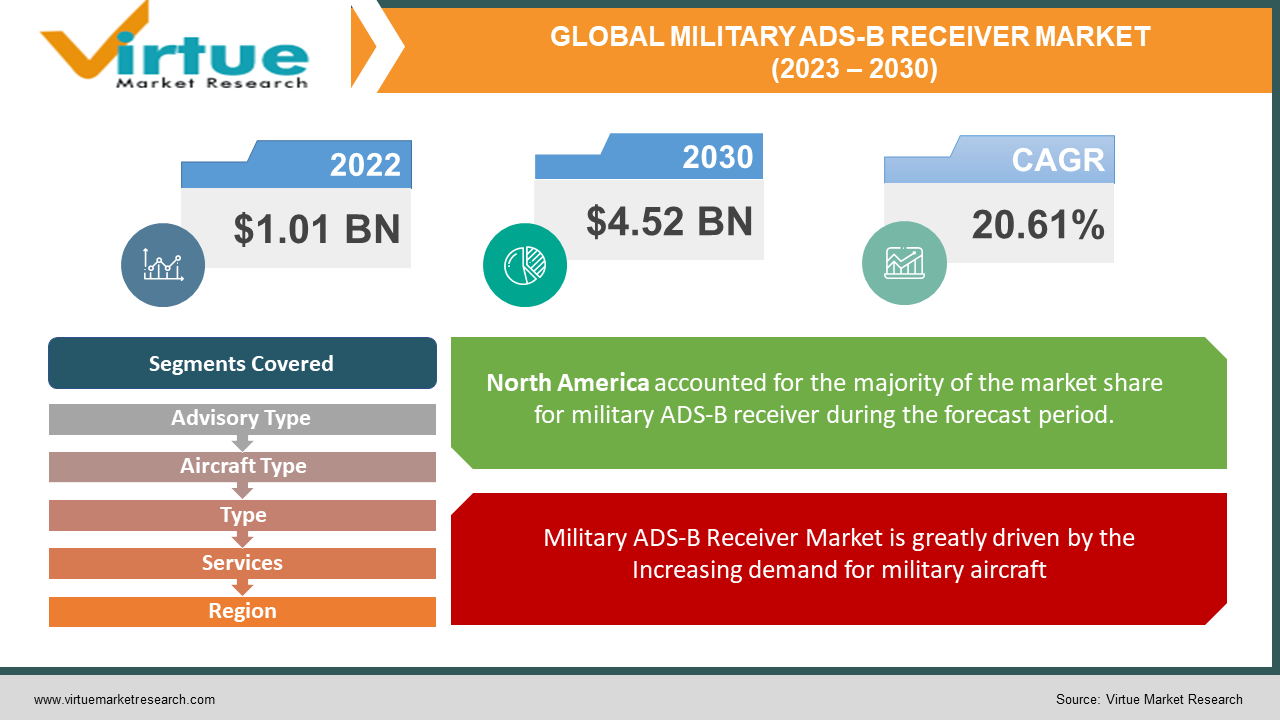
The Automatic Dependent Surveillance-Broadcast (ADS-B) receiver market is a specialty sector of the military communications market. ADS-B technology allows for real-time information transfer from aircraft to ground stations, which enhances situational awareness and boosts safety. Armed forces use military ADS-B receivers to track aircraft in their airspace, identify potential threats, and take quick action in an emergency. The global military ADS-B receiver market is predicted to grow at a CAGR of 20.61% from 2022 to 2030. Due to the growing demand for military aircraft as well as greater situational awareness, the market for military ADS-B receivers is growing.
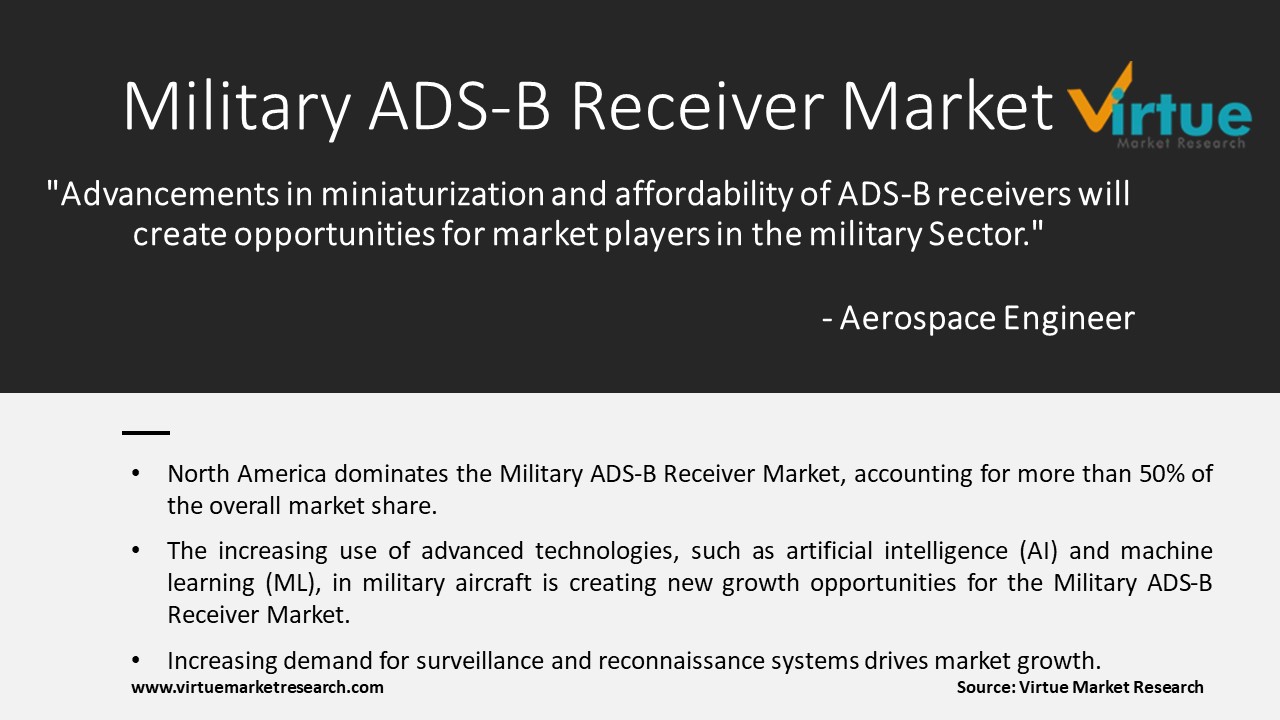
The rising demand for military aircraft and the necessity for better situational awareness is projected to propel the military ADS-B receiver market to considerable growth during the forecast period. North America is anticipated to dominate the market, with Asia-Pacific also experiencing considerable expansion. To increase their market presence and create cutting-edge products, the major industry players are concentrating on partnerships and collaborations.
Global Military ADS-B Receiver Market Drivers:
Military ADS-B Receiver Market is greatly driven by the Increasing demand for military aircraft
One of the key factors propelling the global market for military ADS-B receivers is the growing need for military aircraft. Modern military aircraft are required due to escalating geopolitical unrest and growing security concerns worldwide. Military aircraft producers are continuously concentrating on creating cutting-edge technology to improve the capabilities of military aircraft. Military ADS-B receivers are in high demand since it is necessary to track and monitor the movement of military aircraft. The military ADS-B receivers' access to real-time data for ground stations enables defense personnel to react swiftly to emergencies and spot potential threats. As a result, there is a growing need for military aircraft and an expanding market for military ADS-B receivers.
The growing need for enhanced situational awareness is fuelling market growth.
The rising demand for greater situational awareness is the main factor driving the military ADS-B receiver market. Defense personnel need situational awareness to identify and respond to any threats in their airspace. Defense forces can effectively monitor their airspace thanks to the military ADS-B receivers, which provide real-time information on aircraft activities. Due to the need for real-time information and the increasing complexity of military operations, military ADS-B receivers are in great demand. Defense forces are focusing on fusing cutting-edge technologies like machine learning (ML) and artificial intelligence (AI) to enhance the functionality of military ADS-B receivers. The requirement for better situational awareness is driving growth in the market for military ADS-B receivers.
Global Military ADS-B Receiver Market Challenges:
Security issues and cyber dangers related to technology are one of the main obstacles facing the worldwide military ADS-B receiver market. Military ADS-B receivers are susceptible to hacker assaults and data breaches since they send real-time data from aircraft to ground stations. The security of their airspace is continually at risk because to cyber threats that are constantly present. The defense forces must make sure that military ADS-B receivers are safe from cyberattacks and secure. As a result, the security issues and cyber dangers related to military ADS-B receivers offer a serious obstacle to the market's expansion.
Global Military ADS-B Receiver Market Opportunities:
The incorporation of cutting-edge technology like artificial intelligence (AI) and machine learning (ML) represents one of the main market possibilities in the military ADS-B receiver sector globally. The capabilities of military ADS-B receivers can be improved by the integration of AI and ML, which can also deliver more precise and real-time data on aircraft movement. The military ADS-B receiver data can be analyzed by the defense forces using AI and ML to help them make wise decisions. Therefore, the market for military ADS-B receivers has a lot of room to grow as a result of the incorporation of cutting-edge technology.
COVID-19 Impact on Global Military ADS-B Receiver Market:
Manufacturing and deployment of military ADS-B receivers have halted because to supply chain disruptions and production delays brought on by the outbreak. Government spending has decreased as a result of budget constraints caused by the pandemic-related downturn in the economy, which might have an immediate effect on market growth. On the other hand, the epidemic has also led to a heightened emphasis on defense and security as governments try to safeguard their skies and borders. The need for better situational awareness has grown more urgent as a result of the epidemic, which has raised the need for military ADS-B receivers. In addition, the epidemic has accelerated the development of digital technologies, which could ultimately fuel market expansion.
Global Military ADS-B Receiver Market Recent Developments:
In November 2020, to examine potential applications for space-based ADS-B data, Aireon and the FAA have d up. The FAA is granted access to Aireon's real-time air traffic surveillance data. Agreement for the processing of accident investigation data and the examination of airspace safety, among other uses. The alliance also aims to enhance commercial space operations and incorporate data into platforms for autonomous air traffic control. The primary contractor for the undertaking is L3Harris Technologies.
Global Military ADS-B Receiver Market Segmentation:
GLOBAL MILITARY ADS-B RECEIVER MARKET REPORT COVERAGE:
|
REPORT METRIC |
DETAILS |
|
Market Size Available |
2022 - 2030 |
|
Base Year |
2022 |
|
Forecast Period |
2023 - 2030 |
|
CAGR |
20.61% |
|
Segments Covered |
By Advisory Type, Aircraft Type, Type, Services and Region |
|
Various Analyses Covered |
Global, Regional & Country Level Analysis, Segment-Level Analysis, DROC, PESTLE Analysis, Porter’s Five Forces Analysis, Competitive Landscape, Analyst Overview on Investment Opportunities |
|
Regional Scope |
North America, Europe, APAC, Latin America, Middle East & Africa |
|
Key Companies Profiled |
Almaz-Antey Corporation, Appareo Systems, Avionix Software S. L., Copperchase Ltd., Dynon Avionics Inc., Eldis Pardubice S. R. O., FreeFlight Systems, Gables Engineering, Garmin International Ltd., Goodwin PLC |
Global Military ADS-B Receiver Market Segmentation: By Advisory Type
Over the course of the projected period, the FIS-B sector is likely to gain market domination due to the rising demand for real-time flight information and weather updates. The TIS-B category is also predicted to grow quickly due to the rising demand for traffic information to enhance situational awareness. North America is anticipated to have the highest market share, followed by Europe and Asia-Pacific, as a result of the increased adoption of cutting-edge military technology and the presence of important defense contractors in the area.
Global Military ADS-B Receiver Market Segmentation: By Aircraft Type
The Tanker Aircraft, Fighter/Attack Aircraft, Trainer Aircraft, Transport Aircraft, and Other Aircraft categories can be used to categorize the global military ADS-B receiver market. During the forecast period, the fighter/attack aircraft category is anticipated to dominate the market due to rising demand for cutting-edge military aircraft to improve defense and national security capabilities. Due to the growing demand for real-time information on the whereabouts of cargo flights, the Transport Aircraft industry is also anticipated to expand dramatically. In terms of market size, North America is anticipated to have a disproportionately large share of the market, followed by Europe and Asia-Pacific. This trend is mostly due to the region's concentration of major defense contractors and rising expenditure on military aircraft modernization programs.
Global Military ADS-B Receiver Market Segmentation: By Type
The 1090 MHz Technical Service Order TSO-C166b, the 978 MHz Technical Service Order TSO-C154c, the TSO-C195b, and Other types of ADS-B receivers can be found on the market for military use. Due to the extensive use of this standard by manufacturers of military aircraft, the 1090 MHz TSO-C166b segment is anticipated to dominate the market over the projection period. Due to its capability to transmit weather and flight information, the 978 MHz TSO-C154c section is also anticipated to experience significant growth. Due to the rising adoption of cutting-edge military technology and the presence of significant defense contractors in the region, North America is predicted to have the largest market share, followed by Europe and Asia-Pacific.
Global Military ADS-B Receiver Market Segmentation: By Services
The Aviation Routine Weather Reports (METAR), Significant Meteorological Conditions (SIGMET), Airmen's Meteorological Conditions (AIRMET), Non-Routine Aviation Weather Reports (SPECI), NEXRAD (regional and CONUS), and Notice to Airmen (NOTAM) Distant service categories can be used to segment the global military ADS-B receiver market. The increased demand for real-time weather updates to improve situational awareness is likely to propel the Aviation Routine Weather Reports (METAR) segment to market dominance throughout the forecast period. Due to its capacity to deliver comprehensive and precise weather data for a particular region, the NEXRAD (regional and CONUS) market is also anticipated to experience significant growth. In terms of market share, North America is anticipated to dominate, followed by Europe and Asia-Pacific, due to the growing adoption of advanced military technology and the presence of major defense contractors in the region.
Global Military ADS-B Receiver Market Segmentation: By Region
Region-wise subsegments of the worldwide military ADS-B receiver market include North America, Europe, Asia Pacific, South America, and the Middle East & Africa. During the projection period, North America is anticipated to dominate the market due to the presence of significant defense contractors and the US military's growing use of cutting-edge military technologies. Due to the existence of key aircraft manufacturers in Europe and the growing investment in military aircraft modernization programs, Europe is also anticipated to experience significant growth. Due to rising defense spending and the uptake of cutting-edge military technologies by nations like China and India, the Asia-Pacific area is also anticipated to rise rapidly. Due to the growing emphasis on improving national security and defense capabilities in these countries, the Middle East & Africa, and South America are also anticipated to have moderate growth throughout the projected period.
Global Military ADS-B Receiver Market Key Players:
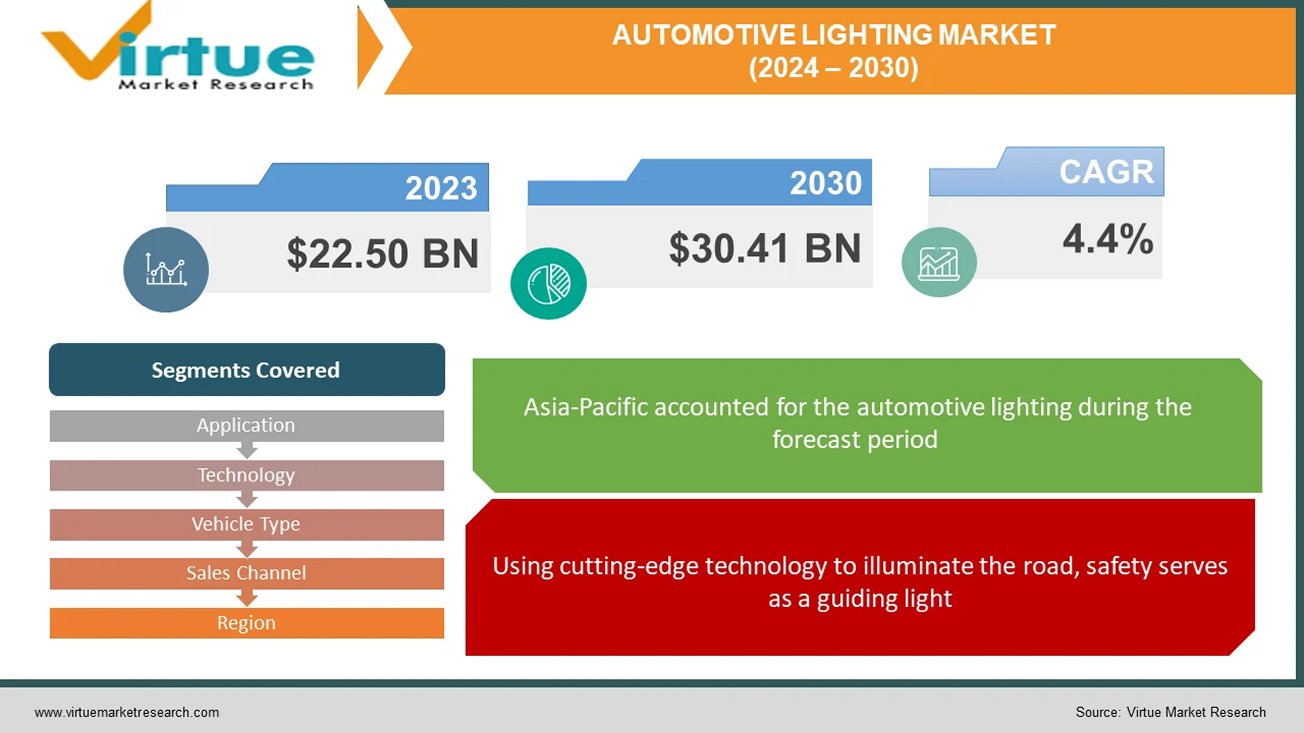
Global automotive lighting refers to all vehicle lighting systems, from headlamps that illuminate the road to taillights that communicate movements. They guarantee motorists and other road users alike safety, visibility, and style. While taillights frequently use LEDs for improved visibility, headlights are available in a variety of technologies, including LED and laser. Interior illumination, DRLs, and signal lights all have a role to play. This market, which was estimated to be worth $33.64 billion in 2022, is anticipated to rise to $67.39 billion by 2030 because of laws, luxury tastes, safety concerns, and technological developments like OLED taillights and adaptive headlights. Anticipate a future dominated by intelligent, connected, personalized, and sustainable lighting systems that enhance the safety, efficiency, and aesthetic appeal of automobiles.
Car lighting works its magic to provide safety, visibility, and style. Headlights cut through the night, taillights express intent, and interiors shine with comfort. The billion-dollar global business is expected to rise due to consumer demand for high-end experiences, safer roads, and cutting-edge technology. Imagine dynamic messages being painted by taillights, headlights that adjust to the road, and interiors that customize their atmosphere. Driven by technological advancements like linked systems and laser beams, this future is calling. Anticipate even more visually attractive, environmentally friendly, and intelligent lighting to illuminate the way ahead, making cars safer, more efficient, and unquestionably cooler.
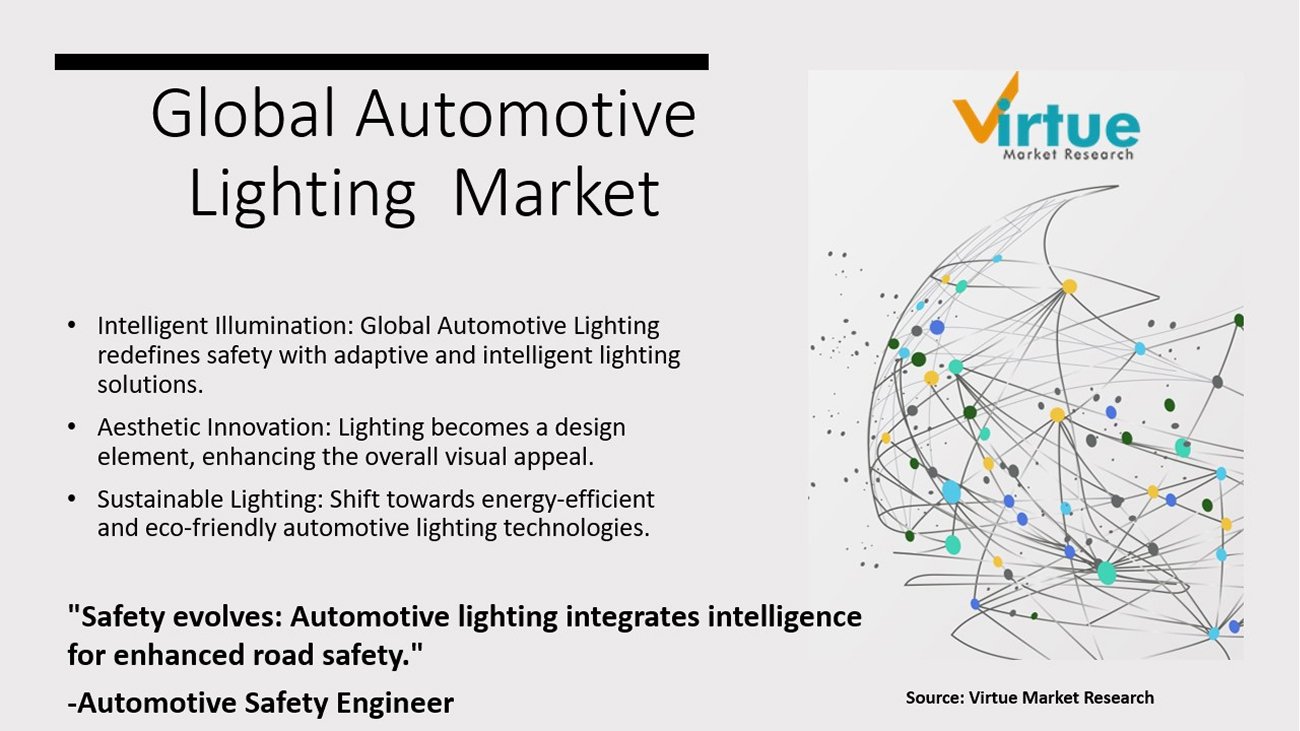
In the market for automobile lighting, safety is the driving force behind demand from the public and laws. While automated high beams smoothly react to traffic, adaptive headlights modify their beams so as not to blind other people. With visually striking displays, dynamic taillights convey intentions for braking and turning. Beyond these developments, integrated pedestrian identification and lane departure alerts will soon make roads safer and brighter for everyone.
Luxurious automobile lighting creates a distinct visual identity that goes beyond simple illumination. Personalized interior lighting customizes the driving experience by setting the mood with a range of colours and intensities, while intricate designs and distinctive DRLs modify exteriors. As you approach your automobile at night, welcoming lights lead the way, resulting in an interior that is perfectly lit. Not only is this symphony of light aesthetically pleasing, but it also stands as a tribute to luxury. Upcoming developments like gesture-controlled lighting and holographic displays promise to further enhance the experience.
The worldwide automotive lighting market is undergoing a significant transition towards energy-efficient solutions, as environmental concerns gain prominence. LED technology is leading the way, providing a ray of hope for the environment and drivers alike. LED lights beam brighter and use a lot less energy than conventional halogen lamps. There are some tangible advantages to this. For drivers, this translates to increased fuel economy, which lowers petrol prices and lessens reliance on fossil fuels. Greater air quality and a reduction in the transport sector's contribution to climate change are the results of reduced overall emissions.
Although the global automotive lighting business is booming, there are still unknowns. Difficulties impede growth even as innovation propels it with eye catching features like laser beams and adaptable headlights. These technologies are luxury items due to their high cost and difficult integration, which puts producers' abilities to the test. The worldwide patchwork created by unclear legislation limits the potential of innovation. Durability issues persist, particularly when complex systems are subjected to challenging conditions. Ultimately, a lot of drivers still don't fully understand how these improvements can help them. Together, we can overcome these obstacles. The keys to reducing costs are improved production, more seamless integration, and unified regulations. Their full potential can be realized by educating customers about the safety, efficiency, and aesthetic value of these lighting wonders. By working together, we can pave the way for an even brighter and safer future for vehicle lighting.
It is made possible by advanced LED technology, which gives drivers the ability to customize their illumination for the highest level of comfort and flair. Consumers that care about the environment want greener products, and vehicle lighting complies. While solar- and self-powered lighting technologies offer a future powered by clean energy, energy-efficient LEDs lower pollution. The advent of connected lighting systems heralds a new age. Envision automobiles interacting with infrastructure and one another to minimize accidents and enhance traffic efficiency. Integrated headlights with pedestrian recognition provide unmatched safety, while dramatic taillights with eye-catching displays alert onlookers to your intentions. The possibilities are endless in the future. Gesture-controlled interior illumination, holographic displays projected onto the road, and even light fixtures with self-healing capabilities.
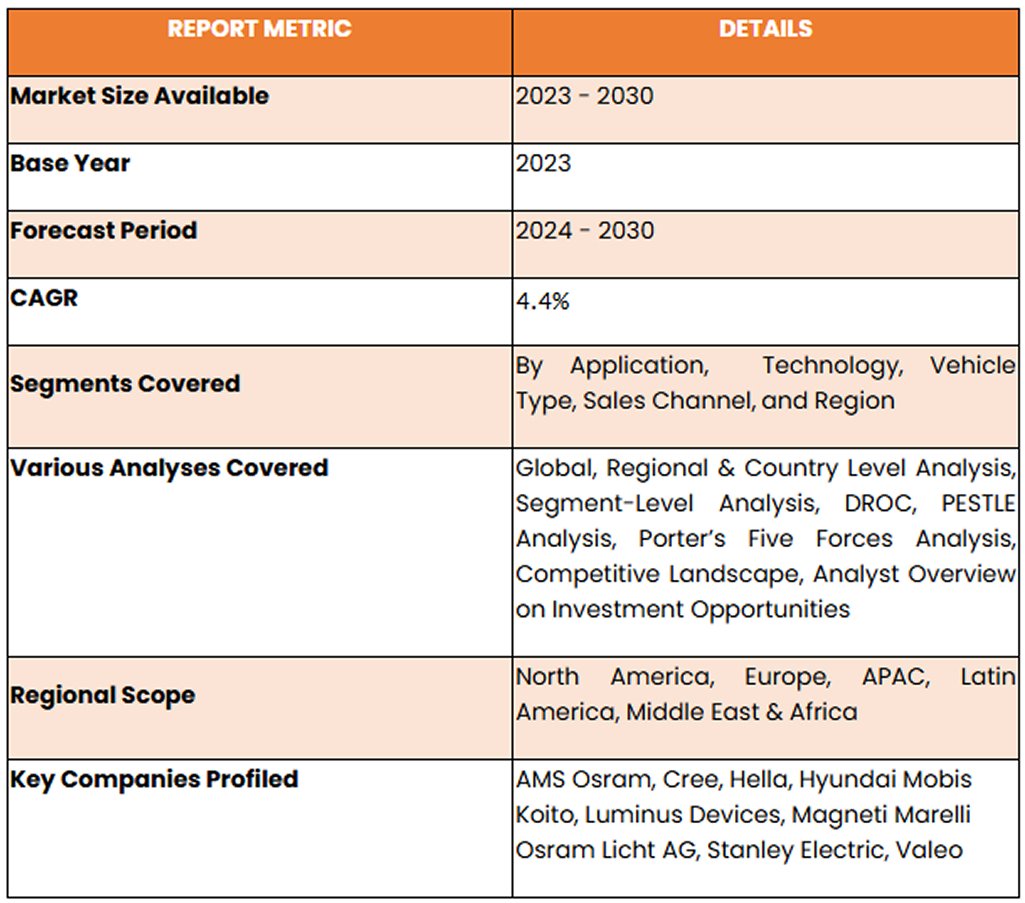
Due to laws requiring safety features like headlights, taillights, and brake lights, exterior lighting presently holds the most market share in the vehicle lighting industry. The dominance of this market is partly attributed to advancements in safety-focused technologies such as adaptive headlights and daytime running lights. The market value of external lighting is increased by the quick adoption of technology like LED bulbs and laser lights, which improve performance and aesthetics. Conversely, the interior lighting market is expected to increase at the fastest rate in the upcoming years. Innovations like ambient lighting and technology breakthroughs like LED and OLED displays, driven by consumer demand for comfort and personalisation, open new possibilities. The spread of sophisticated interior lighting systems is further driven by the growing emphasis on safety and the expansion of the luxury car market.
The worldwide vehicle lighting market is currently dominated by halogen because of its more affordable price, advanced technology, and useful illumination. With its dependable supply chain and affordable option for manufacturers and cost-conscious customers, halogen holds the biggest market share. The fastest-growing market right now is LEDs, which are predicted to shortly overtake halogen. The rapid expansion of LEDs is driven by their higher efficiency, longer lifespan, flexibility in design, and technological breakthroughs including enhanced brightness. Because LEDs use less energy and produce fewer emissions and better fuel economy, they are becoming more and more popular in the changing automotive lighting market.
Passenger automobiles rule the worldwide automotive lighting market. The sheer number of passenger cars produced which surpasses that of business vehicles and fuels the need for lighting systems is the primary cause of this popularity. The growing demand for personal automobiles in developing nations is a result of rising disposable income, which in turn drives the rise of the passenger car market. The importance that consumers place on safety and aesthetics elements helps to drive market expansion. But in the upcoming years, the market for electric and hybrid cars is expected to develop at the quickest rate. The exponential rise of the worldwide electric car market, which is still expanding and shows no signs of slowing down, is what is driving this surge. Specialised lighting solutions are required since electric and hybrid vehicles have different lighting requirements because of their specific functionality and design aesthetics.
Most lighting systems sold nowadays are sold by OEMs (Original Equipment Manufacturers), primarily because manufacturers pre-install lighting systems in new cars. But in the next years, the aftermarket is expected to develop at the quickest rate. This spike in demand for replacement parts, especially lighting systems, can be linked to several variables, one of them being the average age of cars. The industry is expanding because of consumers' growing desire to personalise their cars with aftermarket lighting upgrades such LED upgrades and decorative lighting. The availability and affordability of technologies like adaptive headlights and laser lights in the aftermarket, together with other advancements in lighting technology, are driving demand even more. Moreover, the growing market for electric cars (EVs).
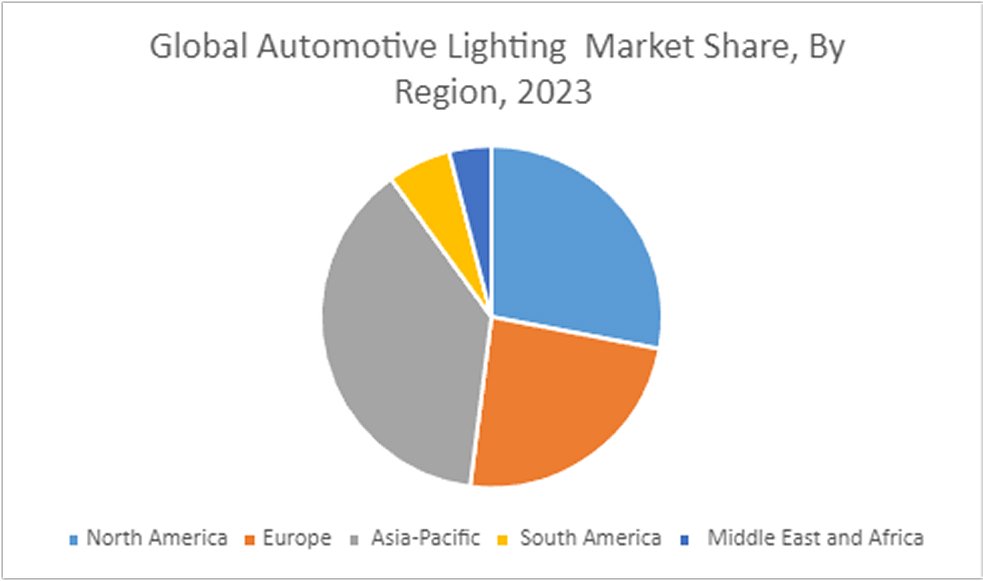
Throughout the forecast period, Asia Pacific is anticipated to be the automotive lighting market with the highest profitability. Over the past few years, Asia Pacific countries like China and India have seen notable increases in automotive manufacturing and sales, primarily in the medium-to premium luxury car segment. Asia Pacific is predicted to see an increase in the manufacturing of passenger cars, with India experiencing the strongest growth rate. Depending on the state of the national economy, the area offers a suitable selection of both high-end and cheap cars. For instance, there is a substantial demand for halogen, Xenon/HID, and LED since China and India produce more economy and mid-range automobiles. On the other hand, luxury car adoption rates are greater in South Korea and Japan, where LED lighting is the norm.
A brief shadow was thrown by COVID-19 over the worldwide automotive lighting market. Production was stopped by lockdowns and supply chain disruptions, while luxury lighting upgrades were shelved by consumers on a tight budget. Resources became scarce, and R&D stagnated. Still, the market is recovering thanks to resurgent demand and rearranged priorities. While energy-efficient LEDs are being pushed towards adoption by sustainability, safety concerns are driving interest in features like pedestrian detection and adaptive headlights. The digital push of the epidemic creates opportunities for intelligent, networked lighting systems that may interact with infrastructure and other cars. Ultimately, the industry is positioned to shine brighter, focused on safety, sustainability, and a connected future, even though the pandemic dimmed its brilliance.
A development collaboration between OSRAM Continental and REHAU aims to incorporate lighting into external components, providing automobile manufacturers with innovative lighting options that improve functionality and design flexibility. For rear combination lamps, Hella unveiled a revolutionary lighting innovation called Hella FlatLight technology. A Memorandum of Understanding (MoU) was signed by Samvardhana Motherson Automotive Systems Group BV (SMRPBV), a division of Motherson Group, and Marelli Automotive Lighting to investigate a technology collaboration focused on intelligently lighted external body components. Valeo debuted their revolutionary 360° lighting system at the Shanghai Auto Show. This technology surrounds the car with a band of light, projecting instantaneous, clear signs that other drivers can see from a distance. Pedestrians, cyclists, and scooter riders are especially susceptible to these signals
The Global Military ADS-B Receiver Market was esteemed at USD 1.01 Billion in 2022 and is projected to a value of USD 4.52 Billion by 2030, growing at a fast CAGR of 20.61% during the forecast period 2023-2030.
The Global Military ADS-B Receiver Market is driven by the Increasing demand for military aircraft.
The Segments under the Global Military ADS-B Receiver Market by Aircraft Type are Tanker Aircraft, Fighter/Attack Aircraft, and Trainer Aircraft.
China, Japan, South Korea, Singapore, and India are the most dominating countries in the Asia Pacific region for the Global Military ADS-B Receiver Market.
Avionix Software S. L, Almaz-Antey Corporation, and Appareo Systems are the three major leading players in the Global Military ADS-B Receiver Market.
Joining thousands of companies around the world committed to making the Excellent Business Solutions.

Specify your preferred Countries, Segments, or timeframes

Unlock Country Level Outlook, Trends, Cross-country Comparability, or supply Chain Variations.



Analyst Support
Every order comes with Analyst Support.

Customization
We offer customization to cater your needs to fullest.

Verified Analysis
We value integrity, quality and authenticity the most.

