
Agriculture Market
In 2025, the global Agriculture Market was valued at approximately USD 12.97 trillion, making it one of the world’s largest and most economically critical industries.
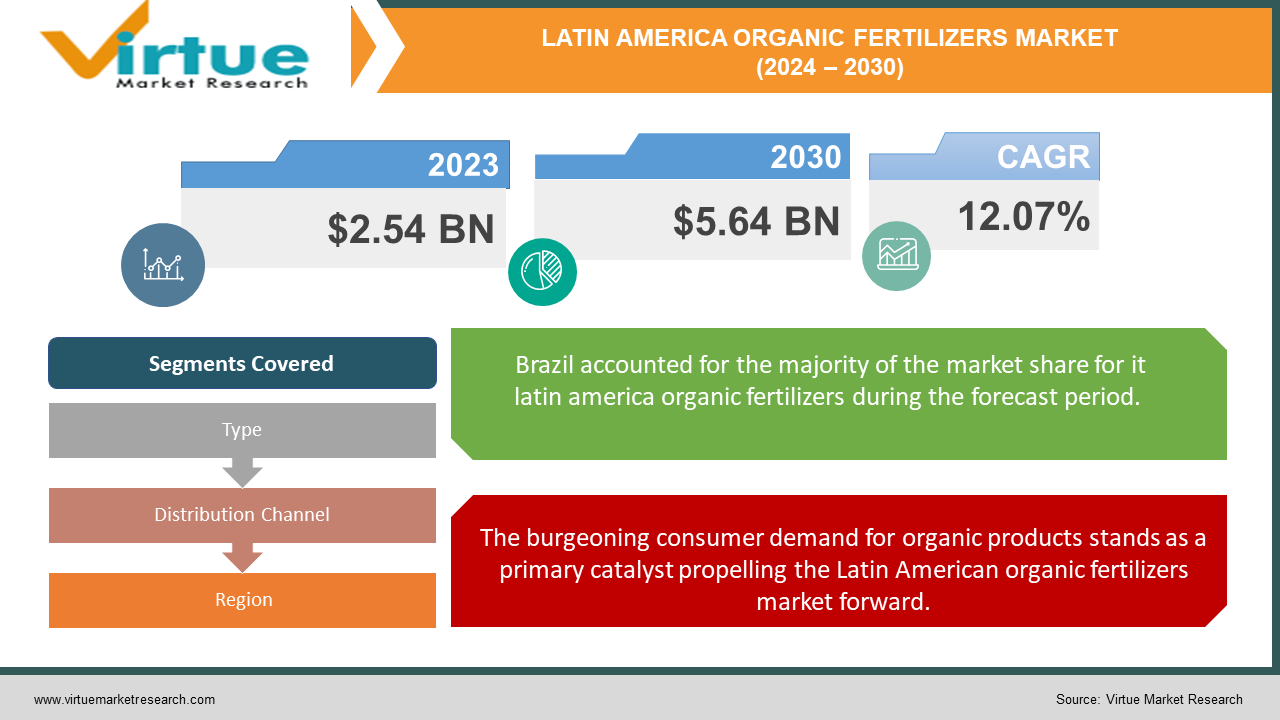
Explore reportThe Latin America Organic Fertilizers Market was valued at USD 2.54 Billion in 2023 and is projected to reach a market size of USD 5.64 Billion by the end of 2030. Over the forecast period of 2024-2030, the market is projected to grow at a CAGR of 12.07%.
Due to a convergence of regionally specific environmental, economic, and social variables, the organic fertilizers business in Latin America is undergoing rapid expansion and reform. Organic fertilizers have become a key component in the search for more environmentally and health-conscious food production systems as knowledge of sustainable agricultural techniques increases and worries about the long-term effects of traditional farming methods develop.
The development of this industry is closely linked to the rich agricultural legacy of Latin America, a continent endowed with a variety of environments, from the lush pampas of Argentina to the tropical settings of Brazil and the highlands of the Andes. Adoption of organic fertilizer has unique difficulties and potential in each of these discrete geographic zones.

Unlock Market Insights : Get Your Sample Report Today
The burgeoning consumer demand for organic products stands as a primary catalyst propelling the Latin American organic fertilizers market forward.
At the heart of this driver is a fundamental shift in consumer consciousness. Latin American consumers, particularly in urban centers and among the growing middle class, are becoming increasingly aware of the health and environmental implications of their food choices. This awareness is not merely a passive acknowledgment but an active force shaping purchasing decisions and, by extension, agricultural practices.
The rise of health-conscious consumerism in Latin America is closely tied to global trends but also reflects unique regional dynamics. As information about the potential risks associated with pesticide residues and synthetic fertilizers becomes more widespread, consumers are seeking alternatives that they perceive as safer and more natural. Organic products, grown without synthetic pesticides and fertilizers, have emerged as the preferred choice for this demographic.
The second major driver propelling the Latin American organic fertilizers market is the growing awareness of soil health and environmental sustainability within the agricultural sector.
At the core of this driver is the recognition that soil is not merely a substrate for growing crops but a complex, living ecosystem that plays a crucial role in agricultural productivity and environmental health. Decades of intensive farming practices, reliant on synthetic fertilizers and pesticides, have led to widespread soil degradation across Latin America.
Issues such as soil erosion, loss of organic matter, and declining biodiversity have become increasingly apparent, threatening long-term agricultural sustainability. Organic fertilizers are seen as a vital tool in reversing these trends. Unlike their synthetic counterparts, organic fertilizers contribute to soil health in multiple ways. They add organic matter to the soil, improving its structure and water-holding capacity. They foster beneficial microbial activity, enhancing nutrient cycling and availability. Moreover, they help sequester carbon in the soil, contributing to climate change mitigation efforts.
The Latin American organic fertilizers market, while experiencing significant growth and potential, faces several notable restraints and challenges that impact its development and widespread adoption. These obstacles span economic, technical, and cultural dimensions, creating a complex landscape for market participants to navigate.
One of the primary challenges is the higher cost associated with organic fertilizers compared to their synthetic counterparts. In many Latin American countries, where small-scale farmers operate on tight budgets, the initial investment required for organic fertilizers can be prohibitive.
The transition period required for conventional farms to switch to organic practices presents another significant hurdle. During this transition, which can take several years, farmers may experience reduced yields as the soil ecosystem adjusts to the new organic inputs. This temporary dip in productivity can be financially challenging for farmers, especially those operating on slim margins.
The Latin American organic fertilizers market, despite its challenges, presents a wealth of opportunities for growth, innovation, and sustainable development. These opportunities span various aspects of the agricultural sector and extend into broader economic and environmental realms, offering potential benefits for a wide range of stakeholders.
Technological advancements present numerous opportunities for innovation in the organic fertilizers market. The development of more efficient composting techniques, precision application methods, and enhanced formulations can improve the efficacy and ease of use of organic fertilizers.
The integration of organic fertilizers with smart farming technologies, such as IoT sensors and data analytics, could lead to more precise and effective nutrient management systems, making organic fertilizers more competitive with synthetic alternatives.
The growing emphasis on soil health and regenerative agriculture offers a platform for positioning organic fertilizers as a key component of sustainable farming systems. As more farmers recognize the long-term benefits of building soil health, there's an opportunity to market organic fertilizers not just as a nutrient source but as a soil health management tool.
|
REPORT METRIC |
DETAILS |
|
Market Size Available |
2023 - 2030 |
|
Base Year |
2023 |
|
Forecast Period |
2024 - 2030 |
|
CAGR |
12.07% |
|
Segments Covered |
By Type, Distribution Channel and Region |
|
Various Analyses Covered |
Regional & Country Level Analysis, Segment-Level Analysis, DROC, PESTLE Analysis, Porter’s Five Forces Analysis, Competitive Landscape, Analyst Overview on Investment Opportunities |
|
Regional Scope |
Brazil, Argentina, Chile and Rest of Latin America |
|
Key Companies Profiled |
BASF SE (Germany), Bayer AG (Germany), The Scotts Miracle-Gro Company (US), Yara International ASA (Norway), Coromandel International Limited (India), Tata Chemicals Ltd (India), Biológica Argentina (Argentina), Brazil EcoAgro (Brazil), Eco Fertil (Brazil), Fertijet do Brazil (Brazil), Agroleader (Colombia), Tecno Huerta (Mexico), Bio-Insumos (Mexico). |
Among these categories, microbial fertilizers stand out as the fastest-growing segment in the Latin American organic fertilizers market. Recent research has shed light on the crucial role of the soil microbiome in plant nutrition and health. This has driven innovation in microbial products tailored to specific crops and soil conditions common in Latin America.
Microbial fertilizers can offer more targeted effects compared to bulk organic fertilizers. For instance, specific strains of rhizobia can be matched to particular legume crops for optimal nitrogen fixation. This precision appeals to farmers looking to optimize their nutrient management strategies.
Animal-based organic fertilizers, particularly manure-based products, remain the most dominant type in the Latin American market. The extensive livestock sector in many Latin American countries ensures a steady, local supply of raw materials.
Farmers have centuries of experience with manure application, making it a trusted option. Animal manures provide a wide range of macro and micronutrients, often in forms readily available to plants. This makes them a "one-stop-shop" for many farmers' fertilizer needs. For many farmers, especially those with integrated crop-livestock systems, manure represents a low-cost or even free fertilizer option. This is crucial in a region where many farmers operate on thin margins.
Traditional agricultural input retailers remain the most dominant distribution channel for organic fertilizers in Latin America. These retailers have long-standing, extensive networks across rural Latin America, often serving as community hubs for agricultural information and supplies.
Many farmers have multi-generational relationships with local agricultural supply stores, valuing face-to-face interactions and personalized service. Retailers offer the advantage of immediate product availability, crucial during critical growing periods when farmers can't wait for deliveries. These stores typically stock a wide range of agricultural inputs, allowing farmers to purchase organic fertilizers alongside other necessary supplies in one visit.
E-commerce sites have been the fastest-growing organic fertilizer delivery method in Latin America in recent years. An atmosphere that is favorable to online commerce has been established in rural Latin America by the rising use of cell phones and internet access. Farmers are getting access to online markets even in isolated farming regions. A new breed of tech-savvy farmers is coming up in the agriculture industry. These younger farmers frequently choose the convenience of digital platforms and are more at ease making purchases online.

With a dominant 45% of the Latin American market for organic fertilizers, Brazil is without a doubt the industry leader. Several factors that have put Brazil in the forefront of the region's organic agricultural movement can be ascribed to this supremacy. Above all, Brazil's immense agricultural area is very important.
Brazil, the largest nation in South America, has a wide range of climatic zones and significant areas of fertile land that make it possible to cultivate a wide range of crops. Due to the complexity of farming practices, there is a strong need for organic fertilizers in a variety of farming sectors, including tiny fruit and vegetable farms and large-scale soybean and maize production.
While Colombia currently holds a 12% share of the Latin American organic fertilizers market, it has emerged as the fastest-growing country in this sector. Several factors are contributing to Colombia's rapid ascent in the organic fertilizers landscape. Colombia's agricultural sector has been undergoing a significant transformation in recent years, with a strong push towards sustainable and organic farming practices. This shift has been driven by both domestic and international factors, creating a fertile ground for the organic fertilizers market to flourish.
Lockdowns and travel restrictions disrupted global supply chains, impacting the import of raw materials and finished organic fertilizer products into Latin America. This created shortages and price fluctuations, leaving farmers scrambling for essential soil amendments.
The initial phase of the pandemic saw a dip in demand for organic fertilizers. Lockdowns and restaurant closures disrupted food service industries, leading to a temporary decrease in the need for organic produce, and consequently, a reduced demand for organic fertilizers among some farmers. Social distancing measures and travel restrictions hampered the movement of agricultural labour, impacting fertilizer production and distribution. This, coupled with limitations on transportation and logistics, posed significant challenges for getting organic fertilizers to farmers.
The pandemic exposed vulnerabilities in global food supply chains, prompting a renewed focus on food security and self-sufficiency in many Latin American countries. This could lead to increased government support for sustainable agricultural practices, including the use of organic fertilizers. Lockdowns and social distancing measures accelerated the adoption of e-commerce platforms in Latin America. This trend can be leveraged by organic fertilizer companies to reach a wider audience of farmers and offer online purchasing options, improving accessibility.
The power of soil microbes is being harnessed. Organic fertilizers enriched with beneficial bacteria and fungi are gaining traction. These "living fertilizers" promote nutrient cycling, improve soil structure, and enhance plant resilience. Imagine bio-fertilizers teeming with microscopic allies, working in harmony with plant roots to unlock the soil's natural potential.
The practice of planting cover crops between cash crop cycles is gaining popularity. These cover crops, nourished by organic fertilizers, suppress weeds, retain soil moisture, and fix nitrogen back into the soil, creating a natural fertility cycle. This eliminates the need for synthetic nitrogen fertilizers, promoting a more sustainable agricultural ecosystem.
Precision agriculture techniques are being applied to the organic fertilizer domain. Soil testing and data analysis are used to create customized blends tailored to specific crops, soil types, and regional climates. Imagine farmers armed with soil data, selecting organic fertilizer blends that precisely address their unique needs, optimizing nutrient delivery and minimizing waste. Blockchain technology can be used to track the origin of organic ingredients in fertilizers, ensuring transparency and building consumer trust. This fosters a more ethical and sustainable supply chain for organic fertilizers.
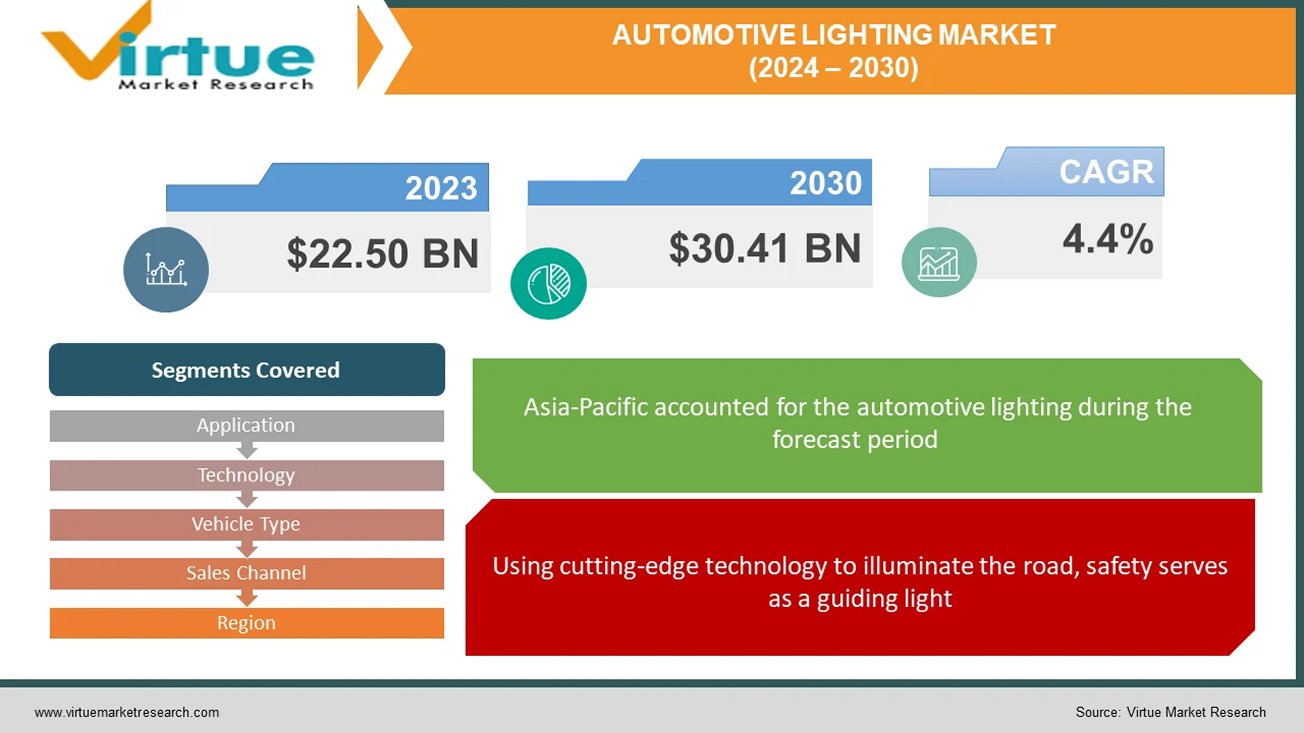
Global automotive lighting refers to all vehicle lighting systems, from headlamps that illuminate the road to taillights that communicate movements. They guarantee motorists and other road users alike safety, visibility, and style. While taillights frequently use LEDs for improved visibility, headlights are available in a variety of technologies, including LED and laser. Interior illumination, DRLs, and signal lights all have a role to play. This market, which was estimated to be worth $33.64 billion in 2022, is anticipated to rise to $67.39 billion by 2030 because of laws, luxury tastes, safety concerns, and technological developments like OLED taillights and adaptive headlights. Anticipate a future dominated by intelligent, connected, personalized, and sustainable lighting systems that enhance the safety, efficiency, and aesthetic appeal of automobiles.
Car lighting works its magic to provide safety, visibility, and style. Headlights cut through the night, taillights express intent, and interiors shine with comfort. The billion-dollar global business is expected to rise due to consumer demand for high-end experiences, safer roads, and cutting-edge technology. Imagine dynamic messages being painted by taillights, headlights that adjust to the road, and interiors that customize their atmosphere. Driven by technological advancements like linked systems and laser beams, this future is calling. Anticipate even more visually attractive, environmentally friendly, and intelligent lighting to illuminate the way ahead, making cars safer, more efficient, and unquestionably cooler.
In the market for automobile lighting, safety is the driving force behind demand from the public and laws. While automated high beams smoothly react to traffic, adaptive headlights modify their beams so as not to blind other people. With visually striking displays, dynamic taillights convey intentions for braking and turning. Beyond these developments, integrated pedestrian identification and lane departure alerts will soon make roads safer and brighter for everyone.
Luxurious automobile lighting creates a distinct visual identity that goes beyond simple illumination. Personalized interior lighting customizes the driving experience by setting the mood with a range of colours and intensities, while intricate designs and distinctive DRLs modify exteriors. As you approach your automobile at night, welcoming lights lead the way, resulting in an interior that is perfectly lit. Not only is this symphony of light aesthetically pleasing, but it also stands as a tribute to luxury. Upcoming developments like gesture-controlled lighting and holographic displays promise to further enhance the experience.
The worldwide automotive lighting market is undergoing a significant transition towards energy-efficient solutions, as environmental concerns gain prominence. LED technology is leading the way, providing a ray of hope for the environment and drivers alike. LED lights beam brighter and use a lot less energy than conventional halogen lamps. There are some tangible advantages to this. For drivers, this translates to increased fuel economy, which lowers petrol prices and lessens reliance on fossil fuels. Greater air quality and a reduction in the transport sector's contribution to climate change are the results of reduced overall emissions.
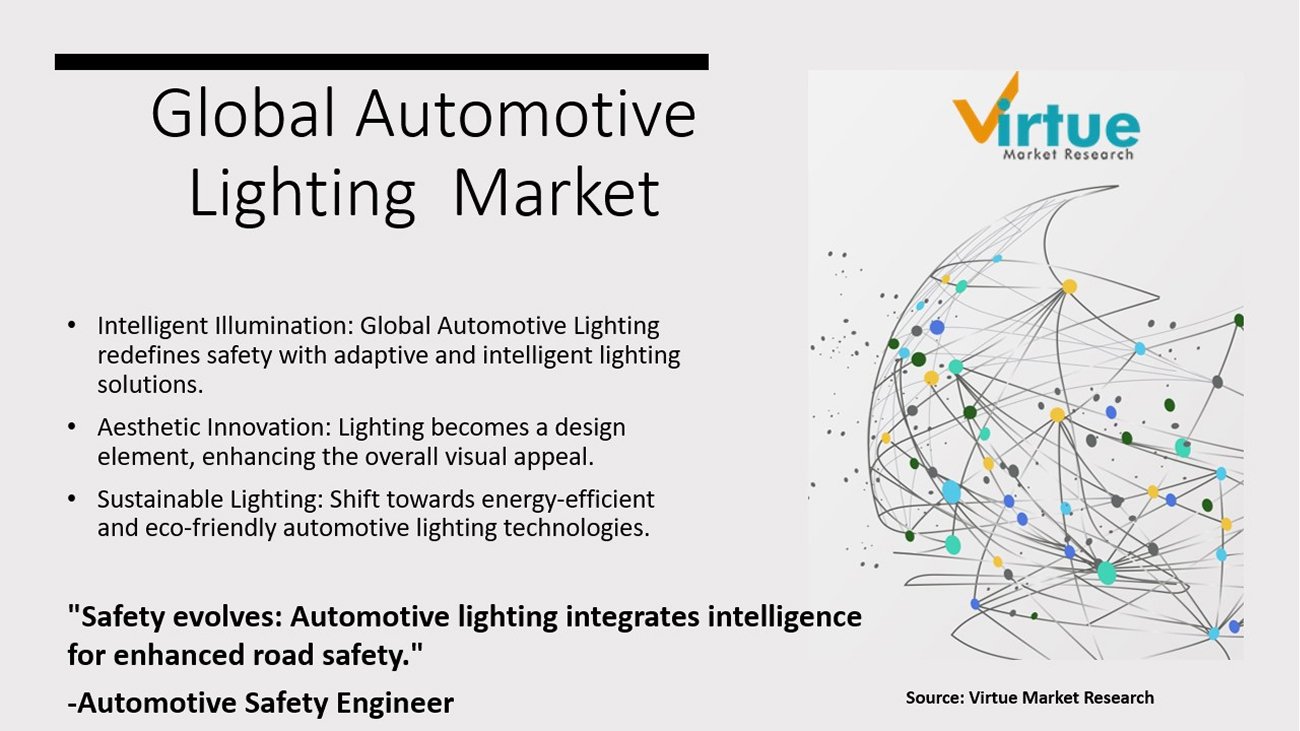
Although the global automotive lighting business is booming, there are still unknowns. Difficulties impede growth even as innovation propels it with eye catching features like laser beams and adaptable headlights. These technologies are luxury items due to their high cost and difficult integration, which puts producers' abilities to the test. The worldwide patchwork created by unclear legislation limits the potential of innovation. Durability issues persist, particularly when complex systems are subjected to challenging conditions. Ultimately, a lot of drivers still don't fully understand how these improvements can help them. Together, we can overcome these obstacles. The keys to reducing costs are improved production, more seamless integration, and unified regulations. Their full potential can be realized by educating customers about the safety, efficiency, and aesthetic value of these lighting wonders. By working together, we can pave the way for an even brighter and safer future for vehicle lighting.
It is made possible by advanced LED technology, which gives drivers the ability to customize their illumination for the highest level of comfort and flair. Consumers that care about the environment want greener products, and vehicle lighting complies. While solar- and self-powered lighting technologies offer a future powered by clean energy, energy-efficient LEDs lower pollution. The advent of connected lighting systems heralds a new age. Envision automobiles interacting with infrastructure and one another to minimize accidents and enhance traffic efficiency. Integrated headlights with pedestrian recognition provide unmatched safety, while dramatic taillights with eye-catching displays alert onlookers to your intentions. The possibilities are endless in the future. Gesture-controlled interior illumination, holographic displays projected onto the road, and even light fixtures with self-healing capabilities.
Due to laws requiring safety features like headlights, taillights, and brake lights, exterior lighting presently holds the most market share in the vehicle lighting industry. The dominance of this market is partly attributed to advancements in safety-focused technologies such as adaptive headlights and daytime running lights. The market value of external lighting is increased by the quick adoption of technology like LED bulbs and laser lights, which improve performance and aesthetics. Conversely, the interior lighting market is expected to increase at the fastest rate in the upcoming years. Innovations like ambient lighting and technology breakthroughs like LED and OLED displays, driven by consumer demand for comfort and personalisation, open new possibilities. The spread of sophisticated interior lighting systems is further driven by the growing emphasis on safety and the expansion of the luxury car market.
The worldwide vehicle lighting market is currently dominated by halogen because of its more affordable price, advanced technology, and useful illumination. With its dependable supply chain and affordable option for manufacturers and cost-conscious customers, halogen holds the biggest market share. The fastest-growing market right now is LEDs, which are predicted to shortly overtake halogen. The rapid expansion of LEDs is driven by their higher efficiency, longer lifespan, flexibility in design, and technological breakthroughs including enhanced brightness. Because LEDs use less energy and produce fewer emissions and better fuel economy, they are becoming more and more popular in the changing automotive lighting market.
Passenger automobiles rule the worldwide automotive lighting market. The sheer number of passenger cars produced which surpasses that of business vehicles and fuels the need for lighting systems is the primary cause of this popularity. The growing demand for personal automobiles in developing nations is a result of rising disposable income, which in turn drives the rise of the passenger car market. The importance that consumers place on safety and aesthetics elements helps to drive market expansion. But in the upcoming years, the market for electric and hybrid cars is expected to develop at the quickest rate. The exponential rise of the worldwide electric car market, which is still expanding and shows no signs of slowing down, is what is driving this surge. Specialised lighting solutions are required since electric and hybrid vehicles have different lighting requirements because of their specific functionality and design aesthetics.
Most lighting systems sold nowadays are sold by OEMs (Original Equipment Manufacturers), primarily because manufacturers pre-install lighting systems in new cars. But in the next years, the aftermarket is expected to develop at the quickest rate. This spike in demand for replacement parts, especially lighting systems, can be linked to several variables, one of them being the average age of cars. The industry is expanding because of consumers' growing desire to personalise their cars with aftermarket lighting upgrades such LED upgrades and decorative lighting. The availability and affordability of technologies like adaptive headlights and laser lights in the aftermarket, together with other advancements in lighting technology, are driving demand even more. Moreover, the growing market for electric cars (EVs).
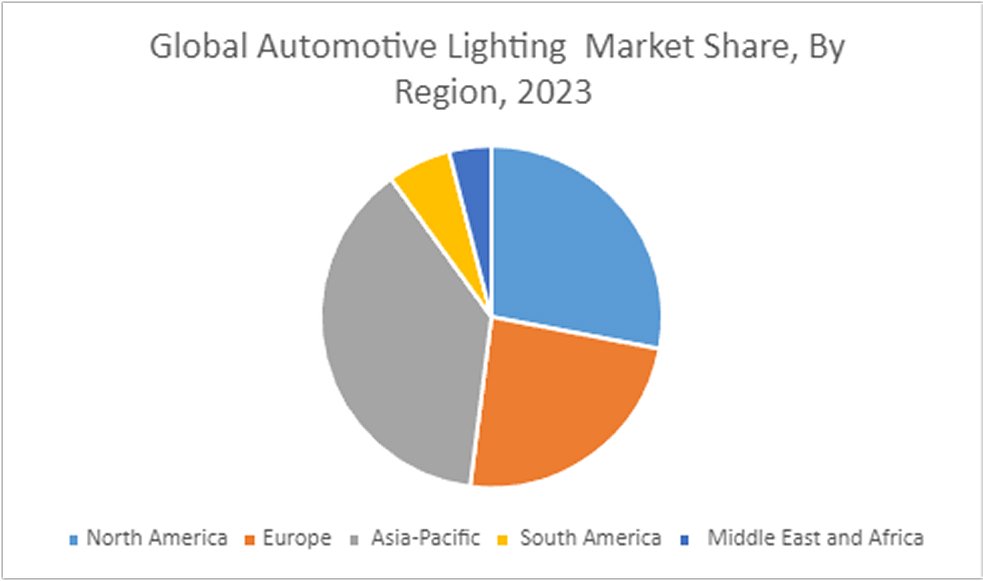
Throughout the forecast period, Asia Pacific is anticipated to be the automotive lighting market with the highest profitability. Over the past few years, Asia Pacific countries like China and India have seen notable increases in automotive manufacturing and sales, primarily in the medium-to premium luxury car segment. Asia Pacific is predicted to see an increase in the manufacturing of passenger cars, with India experiencing the strongest growth rate. Depending on the state of the national economy, the area offers a suitable selection of both high-end and cheap cars. For instance, there is a substantial demand for halogen, Xenon/HID, and LED since China and India produce more economy and mid-range automobiles. On the other hand, luxury car adoption rates are greater in South Korea and Japan, where LED lighting is the norm.
A brief shadow was thrown by COVID-19 over the worldwide automotive lighting market. Production was stopped by lockdowns and supply chain disruptions, while luxury lighting upgrades were shelved by consumers on a tight budget. Resources became scarce, and R&D stagnated. Still, the market is recovering thanks to resurgent demand and rearranged priorities. While energy-efficient LEDs are being pushed towards adoption by sustainability, safety concerns are driving interest in features like pedestrian detection and adaptive headlights. The digital push of the epidemic creates opportunities for intelligent, networked lighting systems that may interact with infrastructure and other cars. Ultimately, the industry is positioned to shine brighter, focused on safety, sustainability, and a connected future, even though the pandemic dimmed its brilliance.
A development collaboration between OSRAM Continental and REHAU aims to incorporate lighting into external components, providing automobile manufacturers with innovative lighting options that improve functionality and design flexibility. For rear combination lamps, Hella unveiled a revolutionary lighting innovation called Hella FlatLight technology. A Memorandum of Understanding (MoU) was signed by Samvardhana Motherson Automotive Systems Group BV (SMRPBV), a division of Motherson Group, and Marelli Automotive Lighting to investigate a technology collaboration focused on intelligently lighted external body components. Valeo debuted their revolutionary 360° lighting system at the Shanghai Auto Show. This technology surrounds the car with a band of light, projecting instantaneous, clear signs that other drivers can see from a distance. Pedestrians, cyclists, and scooter riders are especially susceptible to these signals
The Latin America Organic Fertilizers Market was valued at USD 2.54 Billion in 2023 and is projected to reach a market size of USD 5.64 Billion by the end of 2030. Over the forecast period of 2024-2030, the market is projected to grow at a CAGR of 12.07%.
Organic fertilizers can be more expensive than their conventional counterparts. This can be a barrier for some farmers, particularly small-scale growers operating on tight margins.
BASF SE (Germany), Bayer AG (Germany), The Scotts Miracle-Gro Company (US), Yara International ASA (Norway), Coromandel International Limited (India), Tata Chemicals Ltd (India), Biológica Argentina (Argentina), Brazil EcoAgro (Brazil), Eco Fertil (Brazil), Fertijet do Brazil (Brazil), Agroleader (Colombia), Tecno Huerta (Mexico), Bio-Insumos (Mexico).
The market is dominated by Brazil, which commands a market share of around 45%.
With a market share of about 12%, Columbia is expanding the quickest.
Joining thousands of companies around the world committed to making the Excellent Business Solutions.

Specify your preferred Countries, Segments, or timeframes
Unlock Country Level Outlook, Trends, Cross-country Comparability, or supply Chain Variations.



Analyst Support
Every order comes with Analyst Support.

Customization
We offer customization to cater your needs to fullest.

Verified Analysis
We value integrity, quality and authenticity the most.

