Automotive Graphic Processor Unit (GPU) Market Research Report – Segmentation By Type (Discrete, Integrated); Application (Telematics, Infotainment Systems, Advanced Driver Assistance Systems (ADAS), Others); Region – Size, Share, Growth Analysis | Forecast (2023 – 2030)
Automotive Graphic Processor Unit (GPU) Market Size (2023 - 2030)
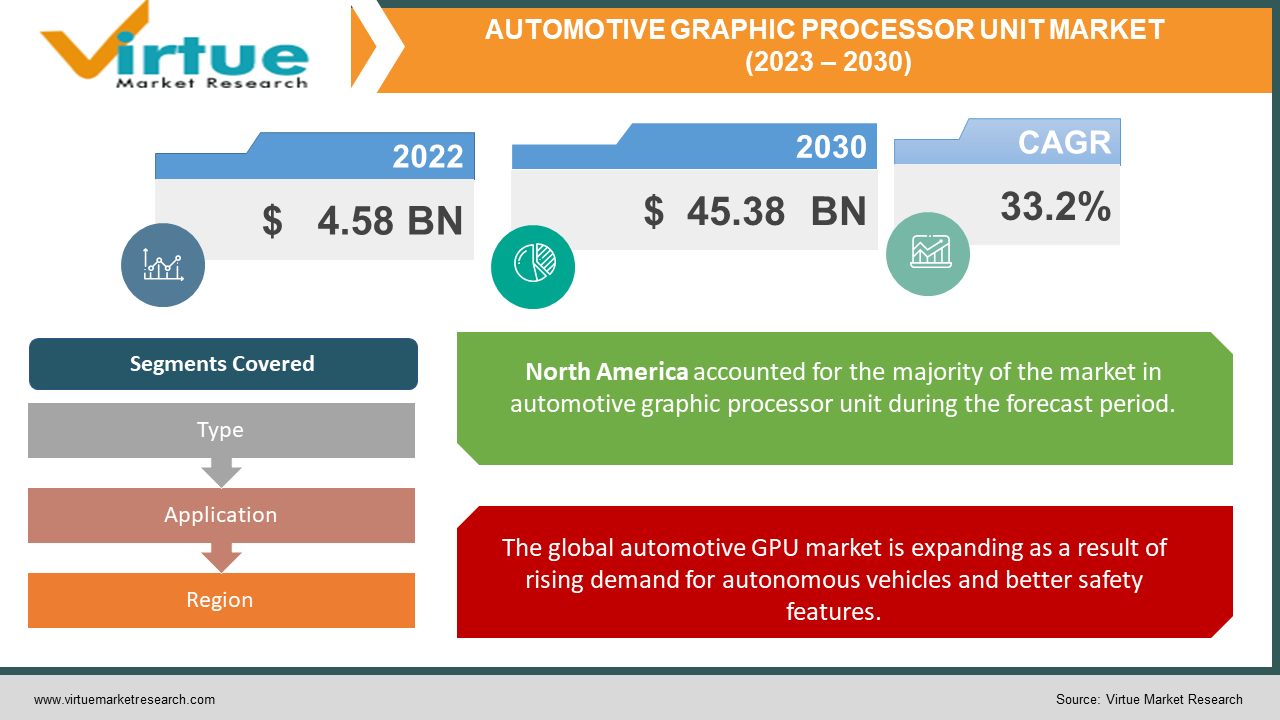
According to our research report, the global Automotive Graphic Processor Unit (GPU) Market size is at USD 4.58 billion in 2022 and is estimated to reach 45.38 billion by 2030. Over the forecast period of 2023-2030, the market is projected to grow at a CAGR of 33.2%.The growing demand for autonomous vehicles, better safety features, and ongoing advancements in artificial intelligence (AI), the Internet of Things (IoT), deep learning, augmented reality (AR), and virtual reality are some factors driving the global automotive graphic processor unit (GPU) market (VR).
Industry Overview :
A computer chip called a graphics processing unit, often referred to as a visual processing unit, is used to create images by quickly performing mathematical calculations. In contrast to CPUs, it has hundreds of cores that can manage thousands of threads at once. While the GPUs found in standalone cards have their RAM, they share the main memory with the CPU in chipsets. Transistors are used in graphics processing units to conduct the mathematical operations necessary for 3D graphics. Dedicated GPUs are being replaced by integrated and hybrid GPUs in applications including supercomputers, virtual reality and augmented reality systems and artificial intelligence platforms.A GPU can be built into a video card or integrated into the motherboard of a personal computer. A range of industry sectors, including the automotive industry, are using CPUs to enable 3D content and graphics applications. For instance, CAD and simulation software allows graphic processing units to create lifelike images or animations, which support manufacturing & design applications. The demand for advancements in GPU technology is also driven by AI, ML, autonomous driving, and navigation (vehicles, robotics).
Modern vehicles need strong GPUs, especially if they are being used for autonomous driving. The automobile sector has experienced tremendous expansion during the past ten years. A powerful GPU (and CPU) is required to drive the artificial intelligence in a Tesla, BMW, Porsche, or any other automobile. The introduction of affordable, effective, and powerful electric cars marked a significant turning point for this industry. Modern vehicles all come with GPUs as standard equipment. The majority of modern cars on the road today have displays, and just like other displays, the rendering of the image requires a computer (a GPU).In some circumstances, code that typically runs on CPUs can be optimized to perform up to 20 times quicker when executed on the GPU as they are massively parallel processing devices. With the aid of an AI accelerator, like the neural network accelerator (NNA) from Imagination, that may be further increased, leading to considerable power savings, which is important as electric vehicles (EVs) is by far the most prevalent platform for autonomous solutions. GPUs are ideally suited for the job when it comes to autonomous vehicle requirements as they can handle parallel signal processing and picture analysis.ADAS platforms can use GPU parallel computing to analyze sensor data from lidar, radar, and infrared cameras in real-time as image processing is a natural fit for this kind of component. This is likely to eliminate human error from the process, resulting in a significant increase in the speed, efficiency, and safety of automotive transportation. To support Level 5 autonomous driving systems, powerful GPUs for all car types are required for gaming, video, and other forms of entertainment.
COVID-19 pandemic impact on Automotive Graphic Processor Unit (GPU) Market
The global automotive graphic processing unit (GPU) market has shown rapid expansion in recent years, but in 2020 the market experienced a sharp decline as a result of the COVID-19 pandemic. The COVID-19 epidemic compelled several governments to impose lockdown, which halted the operations of numerous organizations and had an impact on the global economy. Additionally, numerous businesses around the world have seen a deficiency in hardware components from suppliers.Additionally, production efforts for GPUs have been impacted by the operational disruptions in the electronics sector brought on by the Covid-19 outbreak. The supply chain and distribution channels were affected by the coronavirus pandemic, which in turn had an impact on the sectors that relied on GPU components. Nonetheless, the demand is anticipated to rise as a result of the widespread use of graphics processors in design and engineering applications. The strain on automotive design departments to produce new car innovations quickly, meet the fluctuating expectations of the market, and keep up with an expanding product line is mounting.Research institutions benefited from the expanded computing capabilities of GPU developers and their ecosystem partners during the COVID-19 epidemic.
MARKET DRIVERS:
The global automotive GPU market is expanding as a result of rising demand for autonomous vehicles and better safety features.
The ability of new autonomous systems to quantify uncertainty through real-time simulation, which necessitates quick processing, is crucial to their effectiveness. Examples of these systems include drones and self-driving cars.The fast-developing innovations of autonomous vehicles and improved driver-assistance technologies (ADAS) are becoming more vital. Autonomous vehicles can lessen collisions, save money on fuel, speed up travel, and even give those who are unable to drive access to transportation. By allowing functions like lane detection, lane departure warning, distracted driver warning, and road signs or pedestrian detection, embedded GPUs powered by AI can help autonomous vehicles become smarter. To increase the accuracy and performance of navigation, autonomous systems augment it with high-quality sensor data. This enables a better understanding of the environment. Compared to a standard CPU, the GPU offers greater processing, memory, and efficiency. This market's expansion is also being fueled by the increasing adoption of 3D content and advanced graphics-intensive applications in automobiles. For instance, CAD and simulation programs make use of GPUs to create lifelike animations or graphics to aid production and design applications in the automotive industry.
The industry is expanding as a result of factors such as ongoing developments in artificial intelligence (AI), IoT, deep learning augmented reality (AR), and virtual reality (VR).
A key enabler for completely autonomous vehicles may potentially turn out to be deep learning, a type of machine learning, and an element of artificial intelligence (AI). It is virtually hard to foresee every scenario that a self-driving vehicle might experience. For deep neural networks to learn, adapt, and enhance their problem-solving abilities in real-time, deep learning, which is supported by powerful GPUs, analyses enormous volumes of data. Geo-tagging of images and landmarks can assist deep learning algorithms in autonomous vehicles to dynamically choose travel routes, with sensor integration enabling safe and accurate on-road navigation. Toyota is investigating the use of GPU-powered simulation and deep learning 3 to enhance the intelligence of its self-driving vehicles.With significant advancements in graphics technology and related consumer electronics technologies, achieving full virtual or augmented reality and producing an engaging user experience are now achievable. Graphic processing units are anticipated to become more widely used when AR and VR are integrated into more applications. GPU applications in the Internet of Things (IoT) include dynamic 3D user interfaces and 3D visuals for user interface composite processing.
MARKET RESTRAINTS :
The GPUs used for autonomous driving is built using designs intended for the mainstream market; as a result, they may not have the fundamental characteristics required for safe operation in automobiles.
The computer performance requirements of autonomous driving (AD) systems can be met by GPUs. The GPUs used for autonomous driving, however, may lack essential characteristics required for proper functioning under vehicle safety rules as they are built on designs for the mass market. Under challenging operating circumstances, GPUs are more prone to sporadic hardware flaws (such as extremely high temperatures). Use of ISO 26262 standard solutions, such as diversity and redundancy, should be done with caution while employing GPUs.
The market's expansion may be hampered by difficulties with computational complexity.
Artificial intelligence methods, particularly deep learning, need specialized hardware due to the huge volume of data and the complexity of the computations. For quick parallel calculation, hardware can be highly optimized, such as graphic processing units (GPU) or tensor processing units (TPU). Speed comes at a higher cost and with more energy usage. There is no certainty that a specific algorithm will be able to find a solution under real-time restrictions, even when using specialized technology. Therefore, choosing algorithms carefully takes into account their complexity and CPU requirements in real-time systems. Some cars have a weaker GPU/CPU, which causes the infotainment system to run slowly or not at all. A weaker GPU also restricts the availability of potential new functionalities.
ROBOTICS MARKET REPORT COVERAGE:
REPORT METRIC
DETAILS
Market Size Available
2023 - 2030
Base Year
2022
Forecast Period
2023 - 2030
CAGR
33.2%
Segments Covered
By Type, Application and Region
Various Analyses Covered
Global, Regional & Country Level Analysis, Segment-Level Analysis, DROC, PESTLE Analysis, Porter’s Five Forces Analysis, Competitive Landscape, Analyst Overview on Investment Opportunities
Regional Scope
North America, Europe, APAC, Latin America, Middle East & Africa
This research report on the Automotive Graphic Processor Unit (GPU) market has been segmented based on type, application, and region.
Automotive Graphic Processor Unit (GPU) Market – By Type
Integrated
Discrete
Based on Type, the Automotive Graphic Processor Unit (GPU) Market is bifurcated into Integrated and Discrete. The integrated GPU is embedded with the CPU rather than being provided on a separate card. A discrete GPU is a separate chip that is installed on its circuit board and commonly connected to a PCI Express slot. Thinner and lighter systems, lower power consumption, and reduced system costs are all made possible by CPUs that include a fully integrated GPU on their motherboards. With integrated GPUs, many computing applications can function effectively.
A discrete GPU, often known as a dedicated graphics card, is more appropriate for applications that require a lot of resources and have high-performance requirements. These GPUs increase processing power at the expense of increased energy use and heat production. For discrete GPUs to perform at their best, separate cooling is typically required. With the introduction of cutting-edge technologies like machine learning (ML) and deep learning, the demand for discrete GPUs has rapidly expanded, leading to their use in advanced driving assistance systems (ADAS), the infotainment system, and computing-intensive servers in cars, and other applications.
Automotive Graphic Processor Unit (GPU) Market – By Application
Advanced Driver Assistance Systems(ADAS)
Automatic emergency braking
Blind spot detection
Night Vision
Navigation System
Automatic Parking
Adaptive Cruise Control
Adaptive Headlights
Heads-up Display (HUD)
Pedestrian detection/avoidance
Traffic sign recognition
Lane departure warning/correction
Others
Infotainment System
Telematics
Others
Based on Application, the Automotive Graphic Processor Unit (GPU) Market is bifurcated into Advanced Driver Assistance Systems (ADAS), Infotainment Systems, Telematics, and Others. With the aid of embedded vision, ADAS systems actively increase safety by lowering the likelihood of accidents and occupant injuries. A novel AI function that uses sensor fusion to recognize and process things is integrated into the vehicle's cameras. With the use of image recognition software, ultrasonic sensors, lidar, and radar, sensor fusion combines massive volumes of data like how the human brain processes information. Physically, this technology can react more quickly than a driver ever could. It can instantly evaluate streaming video, identify what it reveals, and decide how to respond. Among these discrete sensors are Light detection and ranging (LiDAR), which uses pulsed laser light to gauge a target's distance, Infrared (IR) cameras systems, which use thermal imaging to see in the dark, and radio detection and ranging (radar), which is similar to LiDAR but uses radio waves rather than a laser. By allowing functions like lane detection, lane departure warning, road signs or pedestrian detection, and distracted driver warning, embedded GPUs powered by AI can make autonomous vehicles smarter. Deep learning algorithms can be used in autonomous vehicles to dynamically determine travel routes with the help of geo-tagging of photos and landmarks. Sensor integration enables accurate and reliable on-road navigation.
Advanced driver-assistance systems (ADAS) based on GPU technology can also lessen human error, which is responsible for 94 % of auto accidents in the US alone and 1.2 million fatalities annually, according to data from the World Health Organization and the National Highway Traffic Safety Administration, respectively. Businesses in the sector have been integrating considerably more sophisticated sensors and cameras to find objects in the area. The bird's eye view parking help is the newest invention. The heads-up display, or HUD, is another recently introduced and practical feature. A HUD's primary function is to show the necessary information on the windshield, which spares the driver from having to look down at the instruments. Alternately, the information is projected directly onto a dedicated, clear display that is mounted in front of the windscreen. Usually used as a speedometer and GPS aid, a car HUD. Numerous optional infotainment system options for new car models are available and can help the driver. The embedded technologies known as telematics are utilized to control several vehicle functions. For instance, telematics systems connect the car to the cloud (V2X) and protect the passengers (eCall and Roadside Assistance.) Telematics is essential for providing over-the-air updates for passenger and vehicle security.
Automotive Graphic Processor Unit (GPU) Market - By Region:
North America
Europe
Asia-Pacific
Rest of the World
Based on regional analysis, the North America Automotive Graphic Processing Unit (GPU) Market is anticipated to account for a significant market share owing to the presence of key market players in the region and rising demand for GPUaaS from the CAD/CAM industry. Within Europe, the automotive graphic processor unit market in Germany is anticipated to grow at a high CAGR during the forecast period. Asia-Pacific holds a considerable share in the global automotive market owing to the huge demand for high graphic computing systems. The presence of numerous gaming sector giants in the region is forecasted to support the APAC market value during the forecast period.
Major Key Players in the Market
Nvidia Corporation
AMD
Intel Corporation
Qualcomm Technologies, Inc.
Imagination Technologies are among the tech behemoths dominating the global automotive Graphic Processing Unit (GPU) Market. Nvidia produces the best discrete graphics cards, while Intel is unrivaled in terms of integrated graphics.
NVIDIA is one of the top innovators in the current market of operations focused on GPU Automotive integrations on a global scale of operability. Nvidia has more than 370 collaborations committed to autonomous driving. The goal of Nvidia is to make self-driving cars more effective and secure. Nvidia is therefore working with organizations like Tesla, Toyota, Volkswagen, and Audi. For completely autonomous systems, NVIDIA DRIVE Hyperion 8 is a computational framework and sensing toolkit.
To compete in the worldwide market, Imagination Technologies has been creating new functional automated driving systems. The virtualization technology capabilities of the PowerVR technology enable it to run several operating systems (OS) on a single GPU core with a little performance impact.
Notable happenings in the Automotive Graphic Processor Unit (GPU) Market in the recent past:
Product Launch- In May 2022, AMD introduced the AMD Radeon RX 6950 XT, the most potent graphics card in the Radeon RX 6000 Series family, the Radeon RX 6750 XT, and Radeon RX 6650 XT graphics cards as new additions to the AMD Radeon™ RX 6000 Series product range.
Product Launch- In January 2021, Qualcomm Technologies, Inc. unveiled its newest line of digital cockpit solutions with the 4th Generation Qualcomm® SnapdragonTM Automotive Cockpit Platforms. The vehicle digital cockpit is transitioning to a zonal electronic/electrical (E/E) compute architecture driven by the cost, complexity, and requirement for a central computing consolidation.
Product Launch- In June 2021, Tesla unveiled a cutting-edge AV training supercomputer. The incredible GPU cluster that supports Autopilot and full self-driving are powered by NVIDIA A100 GPUs. For the highest-performing data centers around the world, NVIDIA A100 GPUs provide acceleration at every scale. The A100 GPU, which is supported by NVIDIA's Ampere Architecture, offers up to 20 times the performance of the previous generation and can be divided into seven GPU instances to adapt to changing demands.
Acquisition- In October 2020, AMD and Xilinx announced signing a legally binding agreement under which AMD will pay $35 billion in all-stock for Xilinx. The acquisition will establish Xilinx as the industry's top high-performance computing business and greatly broaden AMD's client base and product portfolio across a variety of emerging areas. The deal is anticipated to produce market-leading growth and be immediately accretive to AMD margins, EPS, and free cash flow creation. AMD will provide the strongest portfolio of high-performance processor technologies in the market, integrating GPUs, CPUs, FPGAs, Adaptive SoCs, and deep software knowledge to allow industry-leading computing platforms for cloud, edge, and end devices. Together, the combined company will seize opportunities across some of the most significant growth categories in the industry, including data centers, the automobile, aerospace, industrial, PCs, gaming, communications, and defense.
To Learn more about this report,
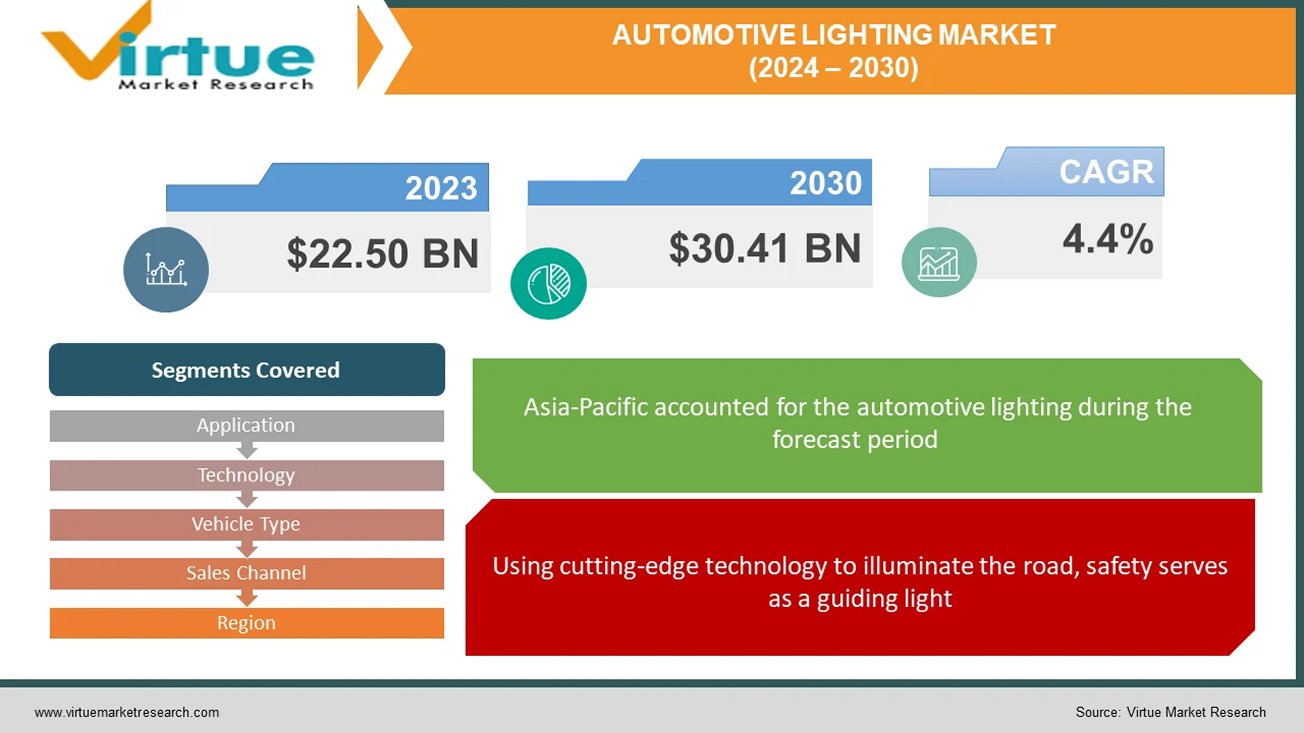
Global automotive lighting refers to all vehicle lighting systems, from headlamps that illuminate the road to taillights that communicate movements. They guarantee motorists and other road users alike safety, visibility, and style. While taillights frequently use LEDs for improved visibility, headlights are available in a variety of technologies, including LED and laser. Interior illumination, DRLs, and signal lights all have a role to play. This market, which was estimated to be worth $33.64 billion in 2022, is anticipated to rise to $67.39 billion by 2030 because of laws, luxury tastes, safety concerns, and technological developments like OLED taillights and adaptive headlights. Anticipate a future dominated by intelligent, connected, personalized, and sustainable lighting systems that enhance the safety, efficiency, and aesthetic appeal of automobiles.
Key Market Insights:
Car lighting works its magic to provide safety, visibility, and style. Headlights cut through the night, taillights express intent, and interiors shine with comfort. The billion-dollar global business is expected to rise due to consumer demand for high-end experiences, safer roads, and cutting-edge technology. Imagine dynamic messages being painted by taillights, headlights that adjust to the road, and interiors that customize their atmosphere. Driven by technological advancements like linked systems and laser beams, this future is calling. Anticipate even more visually attractive, environmentally friendly, and intelligent lighting to illuminate the way ahead, making cars safer, more efficient, and unquestionably cooler.
Global Automotive Lighting Market Drivers:
Using cutting-edge technology to illuminate the road, safety serves as a guiding light.
In the market for automobile lighting, safety is the driving force behind demand from the public and laws. While automated high beams smoothly react to traffic, adaptive headlights modify their beams so as not to blind other people. With visually striking displays, dynamic taillights convey intentions for braking and turning. Beyond these developments, integrated pedestrian identification and lane departure alerts will soon make roads safer and brighter for everyone.
Beyond Performance-Based Luxuries Redefined by Light.
Luxurious automobile lighting creates a distinct visual identity that goes beyond simple illumination. Personalized interior lighting customizes the driving experience by setting the mood with a range of colours and intensities, while intricate designs and distinctive DRLs modify exteriors. As you approach your automobile at night, welcoming lights lead the way, resulting in an interior that is perfectly lit. Not only is this symphony of light aesthetically pleasing, but it also stands as a tribute to luxury. Upcoming developments like gesture-controlled lighting and holographic displays promise to further enhance the experience.
Fuel Efficiency Takes the Lead: Illuminating Sustainability
The worldwide automotive lighting market is undergoing a significant transition towards energy-efficient solutions, as environmental concerns gain prominence. LED technology is leading the way, providing a ray of hope for the environment and drivers alike. LED lights beam brighter and use a lot less energy than conventional halogen lamps. There are some tangible advantages to this. For drivers, this translates to increased fuel economy, which lowers petrol prices and lessens reliance on fossil fuels. Greater air quality and a reduction in the transport sector's contribution to climate change are the results of reduced overall emissions.
To Learn more about this report,
Global Automotive Lighting Market Restraints and Challenges:
Although the global automotive lighting business is booming, there are still unknowns. Difficulties impede growth even as innovation propels it with eye catching features like laser beams and adaptable headlights. These technologies are luxury items due to their high cost and difficult integration, which puts producers' abilities to the test. The worldwide patchwork created by unclear legislation limits the potential of innovation. Durability issues persist, particularly when complex systems are subjected to challenging conditions. Ultimately, a lot of drivers still don't fully understand how these improvements can help them. Together, we can overcome these obstacles. The keys to reducing costs are improved production, more seamless integration, and unified regulations. Their full potential can be realized by educating customers about the safety, efficiency, and aesthetic value of these lighting wonders. By working together, we can pave the way for an even brighter and safer future for vehicle lighting.
Global Automotive Lighting Market Opportunities:
It is made possible by advanced LED technology, which gives drivers the ability to customize their illumination for the highest level of comfort and flair. Consumers that care about the environment want greener products, and vehicle lighting complies. While solar- and self-powered lighting technologies offer a future powered by clean energy, energy-efficient LEDs lower pollution. The advent of connected lighting systems heralds a new age. Envision automobiles interacting with infrastructure and one another to minimize accidents and enhance traffic efficiency. Integrated headlights with pedestrian recognition provide unmatched safety, while dramatic taillights with eye-catching displays alert onlookers to your intentions. The possibilities are endless in the future. Gesture-controlled interior illumination, holographic displays projected onto the road, and even light fixtures with self-healing capabilities.
AUTOMOTIVE LIGHTING MARKET REPORT COVERAGE:
To Learn more about this report,
Global Automotive Lighting Market Segmentation: By Application
Exterior Lighting
Interior Lighting
Due to laws requiring safety features like headlights, taillights, and brake lights, exterior lighting presently holds the most market share in the vehicle lighting industry. The dominance of this market is partly attributed to advancements in safety-focused technologies such as adaptive headlights and daytime running lights. The market value of external lighting is increased by the quick adoption of technology like LED bulbs and laser lights, which improve performance and aesthetics. Conversely, the interior lighting market is expected to increase at the fastest rate in the upcoming years. Innovations like ambient lighting and technology breakthroughs like LED and OLED displays, driven by consumer demand for comfort and personalisation, open new possibilities. The spread of sophisticated interior lighting systems is further driven by the growing emphasis on safety and the expansion of the luxury car market.
Global Automotive Lighting Market Segmentation: By Technology
Halogen
LED (Light-Emitting Diode)
Xenon
Emerging Technologies
The worldwide vehicle lighting market is currently dominated by halogen because of its more affordable price, advanced technology, and useful illumination. With its dependable supply chain and affordable option for manufacturers and cost-conscious customers, halogen holds the biggest market share. The fastest-growing market right now is LEDs, which are predicted to shortly overtake halogen. The rapid expansion of LEDs is driven by their higher efficiency, longer lifespan, flexibility in design, and technological breakthroughs including enhanced brightness. Because LEDs use less energy and produce fewer emissions and better fuel economy, they are becoming more and more popular in the changing automotive lighting market.
Global Automotive Lighting Market Segmentation: By Vehicle Type
Passenger Cars
Commercial Vehicles
Passenger automobiles rule the worldwide automotive lighting market. The sheer number of passenger cars produced which surpasses that of business vehicles and fuels the need for lighting systems is the primary cause of this popularity. The growing demand for personal automobiles in developing nations is a result of rising disposable income, which in turn drives the rise of the passenger car market. The importance that consumers place on safety and aesthetics elements helps to drive market expansion. But in the upcoming years, the market for electric and hybrid cars is expected to develop at the quickest rate. The exponential rise of the worldwide electric car market, which is still expanding and shows no signs of slowing down, is what is driving this surge. Specialised lighting solutions are required since electric and hybrid vehicles have different lighting requirements because of their specific functionality and design aesthetics.
Global Automotive Lighting Market Segmentation: By Sales Channel
OEM (Original Equipment Manufacturers)
Aftermarket
Most lighting systems sold nowadays are sold by OEMs (Original Equipment Manufacturers), primarily because manufacturers pre-install lighting systems in new cars. But in the next years, the aftermarket is expected to develop at the quickest rate. This spike in demand for replacement parts, especially lighting systems, can be linked to several variables, one of them being the average age of cars. The industry is expanding because of consumers' growing desire to personalise their cars with aftermarket lighting upgrades such LED upgrades and decorative lighting. The availability and affordability of technologies like adaptive headlights and laser lights in the aftermarket, together with other advancements in lighting technology, are driving demand even more. Moreover, the growing market for electric cars (EVs).
To Learn more about this report,
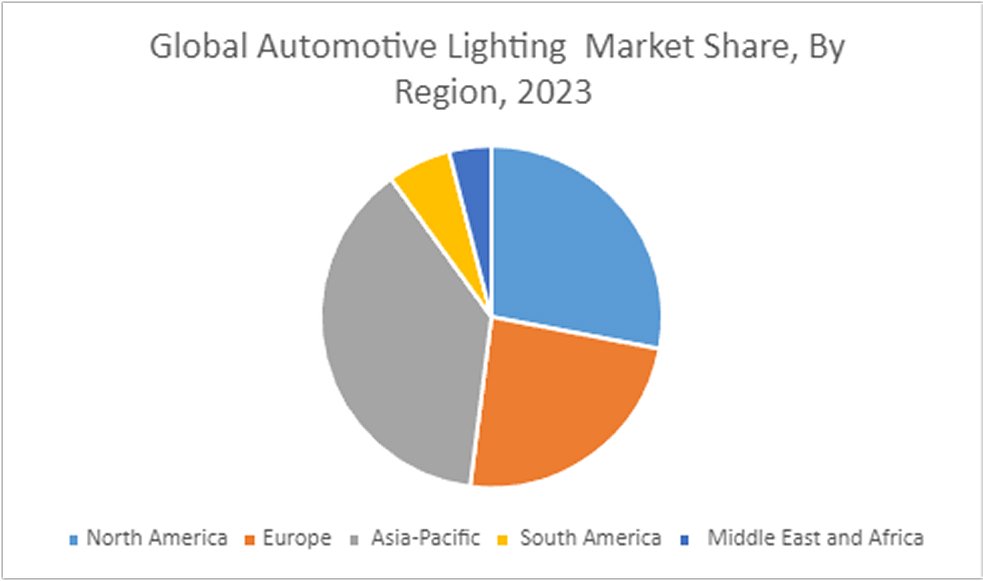
Global Automotive Lighting Market Segmentation: By Region
North America
Asia-Pacific
Europe
South America
Middle East and Africa
Throughout the forecast period, Asia Pacific is anticipated to be the automotive lighting market with the highest profitability. Over the past few years, Asia Pacific countries like China and India have seen notable increases in automotive manufacturing and sales, primarily in the medium-to premium luxury car segment. Asia Pacific is predicted to see an increase in the manufacturing of passenger cars, with India experiencing the strongest growth rate. Depending on the state of the national economy, the area offers a suitable selection of both high-end and cheap cars. For instance, there is a substantial demand for halogen, Xenon/HID, and LED since China and India produce more economy and mid-range automobiles. On the other hand, luxury car adoption rates are greater in South Korea and Japan, where LED lighting is the norm.
COVID-19 Impact Analysis on the Global Automotive Lighting Market:
A brief shadow was thrown by COVID-19 over the worldwide automotive lighting market. Production was stopped by lockdowns and supply chain disruptions, while luxury lighting upgrades were shelved by consumers on a tight budget. Resources became scarce, and R&D stagnated. Still, the market is recovering thanks to resurgent demand and rearranged priorities. While energy-efficient LEDs are being pushed towards adoption by sustainability, safety concerns are driving interest in features like pedestrian detection and adaptive headlights. The digital push of the epidemic creates opportunities for intelligent, networked lighting systems that may interact with infrastructure and other cars. Ultimately, the industry is positioned to shine brighter, focused on safety, sustainability, and a connected future, even though the pandemic dimmed its brilliance.
Recent Trends and Developments in the Global Automotive Lighting Market:
A development collaboration between OSRAM Continental and REHAU aims to incorporate lighting into external components, providing automobile manufacturers with innovative lighting options that improve functionality and design flexibility. For rear combination lamps, Hella unveiled a revolutionary lighting innovation called Hella FlatLight technology. A Memorandum of Understanding (MoU) was signed by Samvardhana Motherson Automotive Systems Group BV (SMRPBV), a division of Motherson Group, and Marelli Automotive Lighting to investigate a technology collaboration focused on intelligently lighted external body components. Valeo debuted their revolutionary 360° lighting system at the Shanghai Auto Show. This technology surrounds the car with a band of light, projecting instantaneous, clear signs that other drivers can see from a distance. Pedestrians, cyclists, and scooter riders are especially susceptible to these signals
Report Code: VMR-19079 | Published Date: February 2026 | Format: Excel and PDF
The Auxiliary Automotive Battery Market was valued at USD 5.30 Billion in 2025 and is projected to reach a market size of USD 7.03 Billion by the end of 2030. Over the forecast period of 2026-2030, the market is projecte...
Report Code: VMR-18896 | Published Date: December 2025 | Format: Excel and PDF
The Self-Driving Cars Market was valued at USD 69.03 Billion in 2025 and is projected to reach a market size of USD 210.36 Billion by the end of 2030. Over the forecast period of 2026-2030, the market is projected to gro...
Report Code: VMR-18893 | Published Date: December 2025 | Format: Excel and PDF
The Luxury Electric Vehicle Market was valued at USD 236.15 Billion in 2025 and is projected to reach a market size of USD 611.36 Billion by the end of 2030. Over the forecast period of 2026-2030, the market is projected...
Report Code: VMR-18838 | Published Date: December 2025 | Format: Excel and PDF
The Motorsports Market was valued at USD 7.02 Billion in 2025 and is projected to reach a market size of USD 13.46 Billion by the end of 2030. Over the forecast period of 2026-2030, the market is projected to grow at a C...
Report Code: VMR-18883 | Published Date: December 2025 | Format: Excel and PDF
The India Electric Vehicle Market was valued at USD 17.86 Billion in 2025 and is projected to reach a market size of USD 95.12 Billion by the end of 2030.
“We received a complex piece of work for our niche market from Virtue Market research in short period of time. I appreciate the quality and content of the final files we received. Thanks for the support”
Medical Devices Company based in Europe
“We received a complex piece of work for our niche market from Virtue Market research in short period of time. I appreciate the quality and content of the final files we received. Thanks for the support”
Medical Devices Company based in Europe
“We received a complex piece of work for our niche market from Virtue Market research in short period of time. I appreciate the quality and content of the final files we received. Thanks for the support”
Medical Devices Company based in Europe
“We received a complex piece of work for our niche market from Virtue Market research in short period of time. I appreciate the quality and content of the final files we received. Thanks for the support”
Medical Devices Company based in Europe
“We received a complex piece of work for our niche market from Virtue Market research in short period of time. I appreciate the quality and content of the final files we received. Thanks for the support”
Medical Devices Company based in Europe
“We received a complex piece of work for our niche market from Virtue Market research in short period of time. I appreciate the quality and content of the final files we received. Thanks for the support”